
The security of almost all Python applications is closely linked to two key factors:
The processes used to develop and maintain them.
The dependencies they use.
A fast, simple, and highly effective way to check whether your Python application contains dependencies with known vulnerabilities is to use Google Open Source Insights.
Open Source Insights is a free service developed and hosted by Google. It helps developers understand the structure, security, and composition of open source software packages. The service analyses each package, builds a complete dependency graph, and makes the detailed results publicly available.
When validating Python projects, the tool provides the following valuable information:
OpenSSF Scorecard (when available) for each project. Note that the Scorecard is not applicable or available for many projects (for example, those that do not run CI/CD workflows on GitHub). The OpenSSF Scorecard provides objective security health metrics for open source projects.
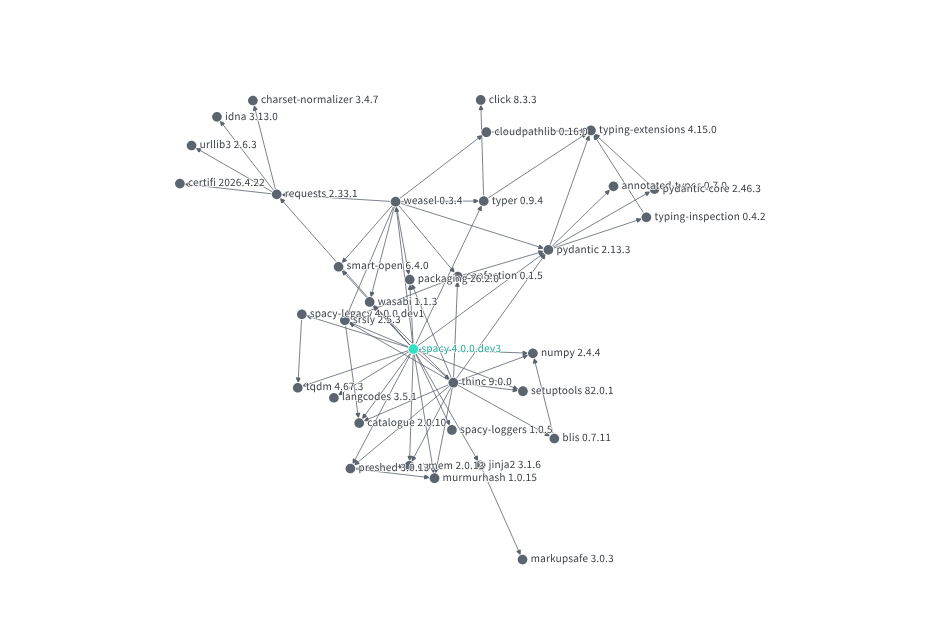
All dependencies — both direct and indirect. You can view them in a clear table format or as an intuitive visual graph. The graph view is particularly useful for quickly understanding which packages introduce additional dependencies.
Dependency definition
A dependency of a package is a separate piece of software that it imports in order to function.
There are two main types:
Direct dependencies: packages explicitly declared as required by the project.
Indirect (transitive) dependencies: packages required by one of your direct dependencies (but not explicitly declared by your project).
The full set of dependencies forms a directed acyclic graph (the dependency graph). Open Source Insights provides an excellent graph viewer for exploring this.
Other categories, such as test or development dependencies, may also exist.
Example: Dependency graph for the spaCy NLP library. All dependencies (both direct and indirect) are also shown in the Graph below. This gives you a clear picture of how widely a package is used across the Python ecosystem.
All dependents — both direct and indirect are shown for a Python package. You can view them in a clear table format.
Dependents definition
A dependent is the inverse of a dependency. If package P depends on package Q, then P is a dependent of Q.
Direct dependents are projects that explicitly import the package. Indirect (transitive) dependents arise through chains of dependencies. Packages with many transitive dependents are often critical to the wider ecosystem — any vulnerability or breakage in such a package can have far-reaching impact.
The overview of dependents is especially useful, as it immediately shows how many other PyPI packages rely on a given library.
Example: Dependents of the click package (v8.3.3)
Security advisories, if any exist, are displayed clearly for each package. (Remember that many vulnerabilities are never publicly disclosed.)