
The emphases in this course is on security testing for Python programs. But if you want to learn more about Secure Coding for Python , check the Secure Coding Guidelines for Python.
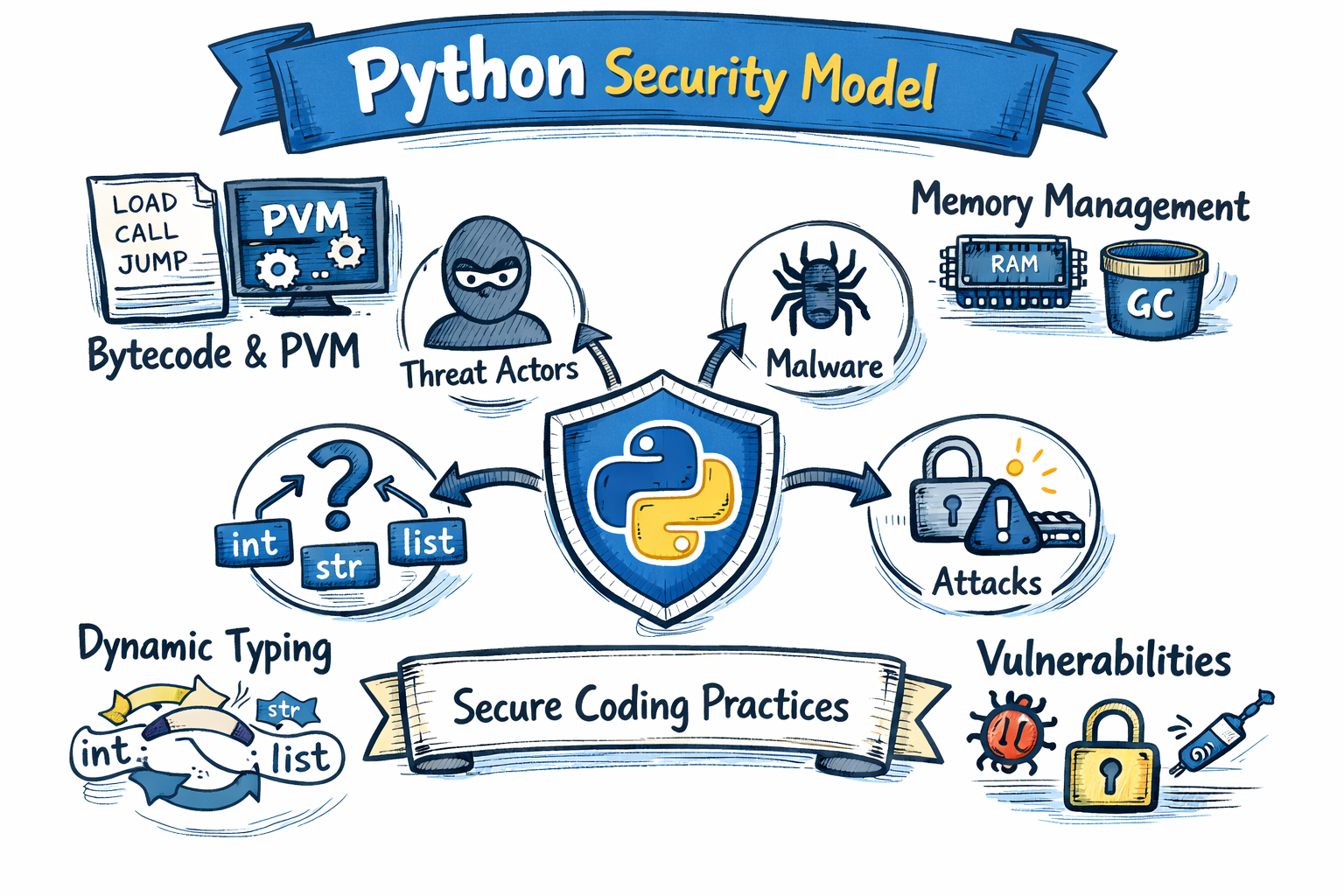
The Core Python Security Model
To effectively protect Python applications against malware and other threats, it is essential to understand Python’s core security model.
Memory Management and Process Safety
Unlike lower-level languages such as C or C++, Python abstracts direct memory access away from the developer. This significantly reduces the likelihood of memory corruption vulnerabilities such as buffer overflows, dangling pointers, or arbitrary memory writes.
Python manages memory through:
Reference counting
Automatic garbage collection
These mechanisms prevent many classic memory exploitation techniques. However, they do not eliminate risk entirely. From a security perspective, you must still consider:
Resource exhaustion (e.g. memory leaks caused by unintended object retention)
Denial-of-service risks through excessive object creation
Abuse of large in-memory data structures
Python protects against direct memory manipulation, but it does not protect against logic flaws or resource misuse.
Code Execution Model and the Python Virtual Machine
Python source code is compiled into bytecode, which is then executed by the Python Virtual Machine (PVM) within the interpreter process.
This execution model has important security implications:
All imported modules execute within the same interpreter process.
There is no built-in sandbox for untrusted code.
Malicious code in dependencies runs with the same privileges as the application itself.
If an attacker can influence what code is imported or executed, they can potentially execute arbitrary instructions within the application’s trust boundary.
For this reason, protecting against malware in Python requires:
Strict dependency management
Careful control of execution environments
Isolation using containers or virtual environments
Least-privilege operating system permissions
Dynamic Behaviour and Security Risks
Python is highly dynamic. This flexibility is powerful, but it also increases the attack surface.
Key dynamic features include:
Dynamic typing
Reflection and introspection
Runtime code execution (
eval,exec)Dynamic imports
Monkey patching
From a malware defence perspective, these features introduce risks such as:
Code injection
Execution of untrusted input
Hidden or obfuscated behaviour
Manipulation of runtime objects
Bypassing of security checks
For example, executing user input through eval() or exec() can lead directly to remote code execution vulnerabilities. Similarly, unsafe deserialisation of data can result in arbitrary object creation and code execution.
Python does not restrict these behaviours by default. The responsibility for safe use lies with the developer.
Trust Boundaries and Attack Surface
A core part of Python’s security model is understanding trust boundaries:
User input is untrusted.
External APIs are untrusted.
Third-party libraries may be compromised.
Deserialised data must be treated as hostile.
Python’s import system, packaging ecosystem, and dynamic execution capabilities mean that the attack surface often extends beyond the application’s own source code. Supply chain attacks, malicious packages, and dependency confusion attacks are real threats in Python environments.
Protecting against malware therefore requires:
Verifying dependencies
Pinning package versions
Reviewing high-risk libraries
Monitoring for known vulnerabilities
Running applications in controlled, isolated environments
No Built-in Sandbox
It is important to understand that Python does not provide a secure sandbox environment for executing untrusted code. Attempts to “restrict” Python by removing certain built-ins or blocking modules are generally insufficient and can often be bypassed.
True isolation must be implemented at the operating system or infrastructure level, for example using:
Containers
Virtual machines
Process isolation
Mandatory access controls
Security Responsibility in Python
Python reduces certain low-level risks through abstraction and managed memory. However, it does not enforce strict runtime security boundaries. Its philosophy prioritises flexibility and developer productivity over restrictive security controls.
From a security testing perspective, this means:
Python security testing is essential.
From a testing perspective you must evaluate how external input influences execution of code.
Security auditing and testing means you must analyse dependency risk.
Security auditing and testing can also involves determining assess privilege levels and validating security of runtime environments.
Understanding Python’s internal execution model, memory handling, and dynamic capabilities allows you to reason about how malware could execute, how attackers could cross trust boundaries, and how to design effective defensive controls.