Essential Checklist for Selecting a Python Security Testing Tool
Selecting a FOSS (Free and Open Source Software) tool for Python security testing isn’t just about finding one that works—it’s about ensuring the tool itself meets strict quality, maintenance, and reliability constraints.
A Python security testing tool should minimal meet the following criteria:
FOSS-licensed: The product must be released under a valid FOSS licence, preferably one approved by the Open Source Initiative (OSI).
Local-first deployment: The tool should run locally or on a server within your own security perimeter. Avoid SaaS-only solutions where you cannot control the execution environment or data handling.
Actively maintained: The project should be active and demonstrate an acceptable level of quality, including regular updates and issue management.
Public version control repository: The source code must be publicly accessible in a version-controlled repository with a clear and verifiable URL.
Ideally, projects should also meet the minimum requirements outlined by the OpenSSF Best Practices Badge Program. However, despite significant effort from the community, this programme is not widely known and adopted.
In practice, you will use a long list when selecting test software for Python. For each tool, you should use a proven checklist that helps you choose a suitable FOSS testing tool for your purpose.
These selection criteria are based on essential Security by Design Principles. The rationale behind them is simple: a security tool should be secure itself and not introduce additional security risks.
Selecting a Static Application Security Test (SAST) Tool for Python
Use a FOSS tool. Free and Open Source Software (FOSS) makes it easier to comply with the proven cybersecurity principle: “Never Trust, Always Verify.” Be cautious of commercial vendors who market their tools as FOSS—too often this is only a marketing claim.
Prefer a local-first solution. Security is critical—especially when dealing with security tools themselves. Avoid relying on remote solutions you cannot control.
Validations on the Python Standard Library (PSL). Ensure that the tool performs crucial security validations on all modules that are part of the PSL that can cause vulnerabilities, and that these checks are enabled by default.
Choose a Python dedicated scanner. General-purpose SAST tools often miss vulnerabilities specific to Python. Since Python has unique syntax and constructs, only scanners designed for Python can effectively detect potential security issues in Python code well.
Look for the OpenSSF Best Practices Badge. Projects that have earned the Open Source Security Foundation (OpenSSF) best practices badge show evidence of a structured self-assessment. While the process is self-reported, it indicates that the maintainers have considered important security practices relevant for trustworthy software.
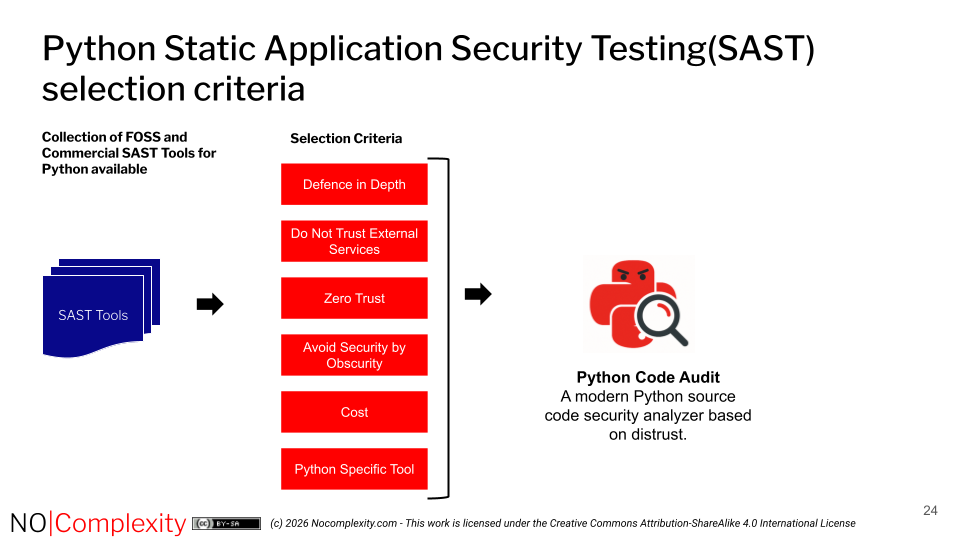
For example, when selecting a SAST tool for Python, you can use the following selection criteria in combination with above mentioned checks: